This is a post of two halves. The first covers covers general activity on Liddells, the second is dedicated to the activity recorded on a camera focussed on one of the nest boxes. As you might imagine, there are a lot of videos. In order to see the videos you will have to go through the Blog section of the website: www.liddells.co.uk
John and Clare hope you enjoy the post in spite of some rather grim aspects.
1st May
The cloudy skies were against Clare seeing the Flower Moon today. It was classified as a micromoon as it was at its furthest point from Earth, making it seem smaller. It is named for the Spring blossoms that occur in May. Fingers crossed for a view of the second full moon this month on 31st - once in a blue moon.
3rd May
International Dawn Chorus Day and Clare got up in the dark, dressed in as many warm clothes as she could and went downstairs only to discover it was raining spectacularly heavily. No Dawn Chorus this morning.
While not officially a storm, the weather reminded Clare of a phrase she had heard recently - ‘lambing storm’ - referring to the typically unsettled weather that happens during lambing season.
4th May
Clare joined in with an annual Dawn Chorus provided by her choir. Since 2008 many members of the choir join forces at the local bandstand and sing in the sunrise. It is bonkers but fun. And the weather was better than yesterday.
Clare has been uncertain for a while about whether or not to restart bee-keeping after the disappointments and colony failures of the last few years, however she has decided she is not quite ready to stop. The apiary needed some attention, particularly from the explosion of Blackthorn regeneration. The area was resembling a thicket. Armed with her chain saw and John with his strimmer, they cleared round and in front of the hive stands. This involved cutting and moving a lot of Blackthorn brash and Clare couldn’t help feeling as if she was re-enacting the scene from The Scottish Play when Birnam Forest apparently moves to Dunsinane.
5th May
More work in the Apiary. Clare was accompanied by a Garden Warbler singing close by for most of the time and was delighted to discover it was her ‘Bird of the Day’ on Merlin.
While John and Hal worked on replacing some seats in the Story-telling Circle (and adding another on the list of seats to be replaced after Clare sat on one and it broke under her), Clare walked round enjoying whatever caught her eye. She noticed an unusual number of St Mark’s flies on the tubes for the new hedging. Read more about this insect here. The flies on the tubes may have been females waiting for mates. There wasn’t a single tube without several flies. Clare wondered if the plastic, warmed by the sun, offered a cosy place to bask. Or they were waiting for the Hawthorn plants inside to grow for their nectar source.
Field Maple leaves unfolding
7-spot ladybird on a Field Maple
Cuckoo Flower on the Wetland
Levelling up
St Mark’s flies
Corsican Pine ‘flower’
Ruth sent John and Clare the BTO results for her ringing on Liddells last year. CES stands for the Constant Effort Sites Scheme, a standardised bird-ringing programme. Volunteer ringers capture birds at the same locations for identical amounts of time each breeding season to monitor population sizes, breeding success, and survival rates. You will see that the results are rather encouraging.
8th May
Clare decided to have another attempt to listen to the Dawn Chorus. Up early and, dressed appropriately she left the house only to drive into thick mist after a few hundred yards. Not only was it unsafe to carry on, no birds with any sense would be out and singing. Heigh ho. Next year perhaps.
While John used the flail mower to cut the paths, Clare had repairs to tackle. She set about patching the holes in the Meadow fencing that had been caused by sheep making a bid for freedom or for the allegedly greener grass on the other side. It was probably one of the more unusual sewing challenges she has faced (and bear in mind she has made two arm-operated goose puppets for pantomime use). Ok, since you ask…
The repairs will be put to the test later this year when the sheep return to graze.
Before…
and after
Second gap closed
Needing a bit of a stretch after all the bending, Clare walked around and found some Water Avens that had found their way onto the Meadow (a welcome addition), Adder’s Tongue Fern also in the Meadow, Stitchwort in flower on the Wetland, Woodruff and Water Avens blooming in the north-west corner and Marsh Marigolds aka Kingcups by the stream in the Pit Wood. She also noted Forget-me-not, Germander Speedwell, Cow Parsley, Bittercress, Ribwort Plantain, Perennial Cornflower, Red Campion and Wild Garlic. She saw a Painted Lady butterfly which perched for a brief moment but with closed wings.
Greater Stitchwort
Woodruff
Water Avens
Clare also had a peek in a couple of nest boxes and found a Blue Tit sitting in 3 at the top of the Scrub.
10th May
John celebrated his birthday and made use of Hal to help with a gate and post that needed repair on the Hayfield.
‘The’ leveret appears in the Scrub again. Of course there is no way of knowing whether this is the same leveret as previously or a different one. Lovely to see, either way.
11th May
Ruth had another ringing session and although there was no evidence of Whitethroats, she reported ringing Song Thrush, Coal Tit and Long-tailed Tit as new species for this season; she also caught a couple of Bullfinch ‘among the ususals’, and heard ‘tons of Goldcrests’, so expects them to appear in her nets soon.
John arrived later and worked on the gatepost.
There has been much deer activity in the Scrub. The exact dates uncertain, however for reasons that will become apparent, the following videos are captured before 13th May. Below is the oldest buck demonstrating mastery over his territory.
Four videos are joined next. They show three different bucks seeking to establish territory: the oldest buck (thick neck, well developed antlers), a middle buck (thinner neck, slightly smaller antlers and at one point seen with a piece of velvet dangling from his antlers and with a babyish looking face) and the youngest buck (smaller altogether and antlers hardly branched at all). They anoint over each other’s anointing and chase each other off.
12th May
Clare was preparing for one of her bimonthly arts events - this time the theme was PETS - and looked up words that began ‘pet-’. She was thrilled to come across ‘pettichaps’: an alternative word for the Garden Warbler according to the OED. The dictionary says the word can also be applied to other species of warbler and/or the Long-tailed Tit; the earliest evidence for ‘pettichaps’ is from 1673, in the writing of John Ray, naturalist and theologian; the etymology suggests the word derives from ‘peti/petit/petty’ meaning small; ‘chaps’ refers to the jaw or beak.
13th May
On their way to Liddells Clare and John noticed a fallen stretch of wall on the Meadow. It was too big a length for them to tackle so they called on the wonderful Gavin to come up do the repair.
They then conducted the first nesting box survey of the season. They found 9 boxes definitely in use (either eggs present or birds sitting), with 8 or 9 more that could still be (one might be being used by a squirrel, hence the uncertainty over numbers). On her way round Clare found a previously unnoticed patch of native Bluebells near the surviving Elms in the Pit Wood. Pond Maggiore has Water Violets in flower.
Unfortunately John came across a dead deer in the Top Strip. He gave it a quick examination and could find no obvious cause of death. It seems to be the young (‘candle’) buck from last year’s twins. John and Clare leave any carcasses. It will be recycled in its own way.
15th - 17th May
John continued working on the gate, post and tightening the adjacent fence.
Gavin mended the wall.
Keith and Clare met early to carry out the annual breeding bird survey - it was cold and windy and there were far fewer birds either seen or heard this year. Maybe 2026 is not a good year for early birds. You can see the results here.
Clare had brought home one of the hives to clean out ready for the new year. She set about emptying all the frames and disinfecting them and the box in case there had been any disease.
18th May
Working on the apiary preparation, Clare decided to tackle the bee shed. She might have neglected it in the last twelve months, however mice and wax moths had been busy. Clare sorted out redundant equipment, including a box of frames taken over as a mouse nest site and stuff that needed cleaning; she conducted an equipment audit and put everything back in a better state than on removal.
19th May
The oldest buck seems to choose to pick up a small branch as part of his territorial assertions.
The Middle buck (or younger one now), shows his summer coat emerging.
21st May
John completed the work on the gate, posts and fence straining between the Hayfield and the Top Strip.
22nd May
Clare started work on tidying up the steps over the Point of View then noticed that the Yellow Rattle has started coming into flower.
Early this morning Clare read an article by Phil Gates in The Guardian’s ‘Country Diary’ column in which he drew attention to the nectar and pollen available from newly opened flowers at this time of year. He says ‘none delivers its pollen with such deception and violence as broom (Cytisus scoparius)’. He describes why: ‘A large bumblebee arrives, settles briefly, finds no nectar and departs, leaving a deranged tangle of stamens protruding from the petals. What Happened? Poking my finger into an intact flower, to mimic the visitor, there’s an explosion of pollen as 10 stamens and a coiled stigma break free. Simultaneously, they deliver and collect pollen, with a gut-punch to the insect’s furry abdomen.’ You can read the whole article here. Clare went to look at the Broom at the top of the Crag but saw no bumblebees.
Hal came to help John finish refurbishing the Story-telling Circle. Thanks to him for the photos of John working.
The greatest treat and delight of the day was when Clare believed she heard, and Merlin confirmed, a Greater Whitethroat at the bottom of the Scrub. Returning later than expected, Clare and Ruth had almost assumed there would be none this year, so it was especially good to hear. Clare kept hearing it, or them as there might be two, throughout the day. Here is a recording of a Garden Warbler, Wren and Whitethroat singing at the top of the Hayfield.
Back at home Clare has been cleaning and sterilising brood boxes, nucleus boxes and frames and then adding wax to the frames. She contacted her bee-keeping mentors to see about the possibility of buying a new colony or two. There may be one available in a few weeks providing the queens have mated well and produced colonies of quiet bees.
25th May
Milkwort is out on the Crag and Pignut in the Hayfield and Meadow.
26th May
Clare checked to see whether there had been any developments in the nest boxes with the beginnings of nest construction. She found chicks in two of them. Ruth arrived later and started ringing nestlings, ringing 2 broods of 7 Great Tits, 1 brood of 7 Blue Tits and 1 brood of 3 Coal Tits. She left four broods of Blue Tits to ring in the next few days.
John saw a Large Red Damselfly near the Hayfield so Clare headed for Pond Maggiore. On the way she spotted a pair of Blackbirds bathing in the Roadside pond. There were Large Red Damselflies on Pond Maggiore, some mating, also Common Blue Damselflies and a male Broad-bodied Chaser. Beside the pond a fly caught her eye. It is a Tetanocera elata, a species of Marsh Fly. Apparently the young can eat aquatic snails so they will be playing a part in controlling the pond snails.
Bistort is out on the Meadow.
27th May
Clare positioned a camera in the Pit Wood pointing towards an area that seems to have been used for the does to kid. Previous years’ footage have often shown the does and kids coming on to the main path from here. Thus far there have been very few clips of does, however bucks, old and younger, have been around and confounding John. The next video will illustrate why. Both bucks here are quite young, possibly even the same age. It is possible they could be the two bucks from triplets born three years ago. They don’t seem to be in competition with each other here.
30th May
Clare visited the Meadow to look for signs of Orchids. There were plenty of leaves emerging. She also noticed that quite a large patch of Bird’s Foot Trefoil had spread around the remains of a wall in the middle of the Meadow where Silverweed has also taken. Clare was delighted by the profusion of yellow flowers. She was also struck by the flower head of a Marsh Thistle which looked like a small bouquet and she noticed that Heath Speedwell, looking like tiny trees, was in flower on the Crag.
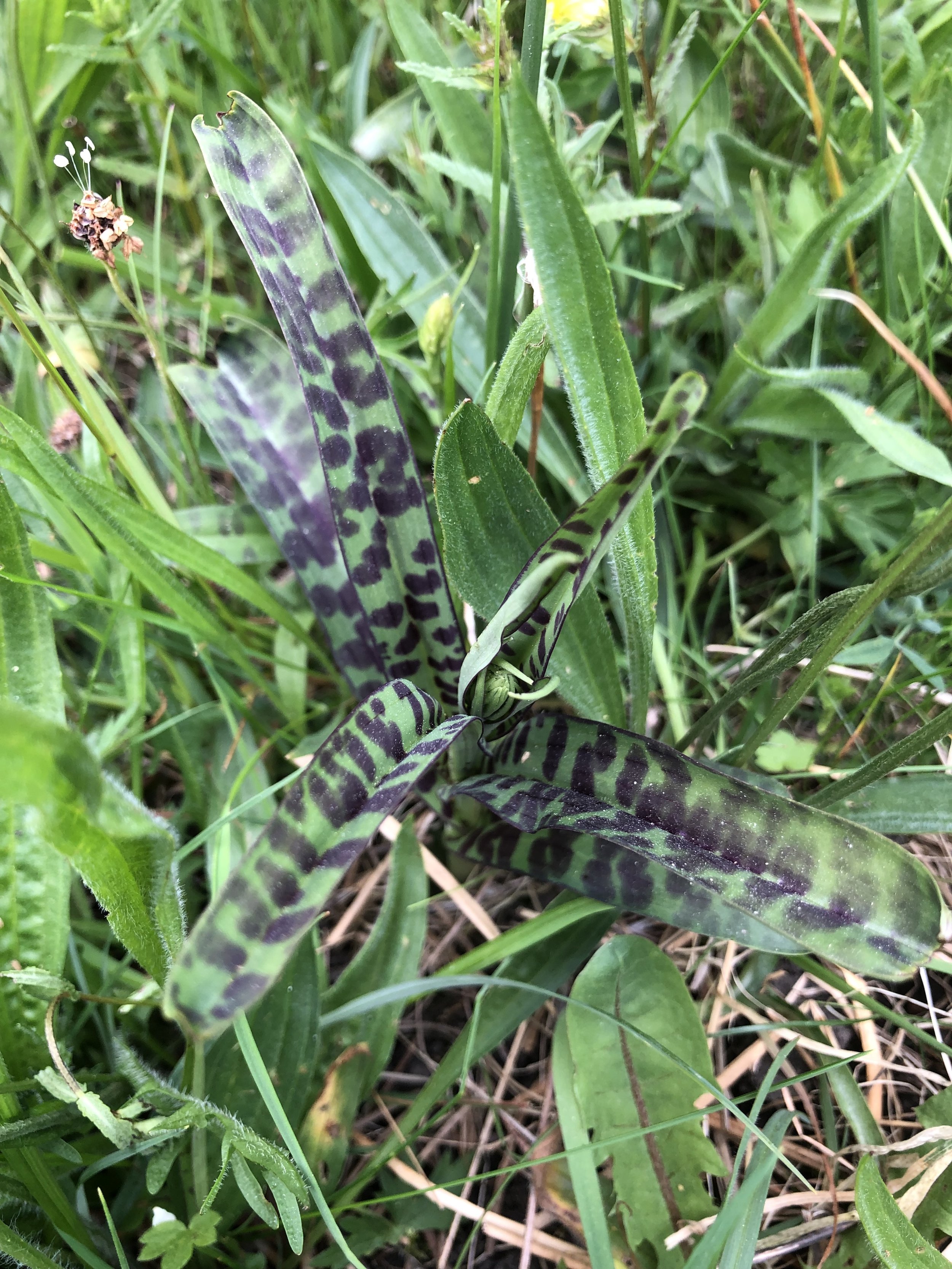
Common Spotted Orchid leaves
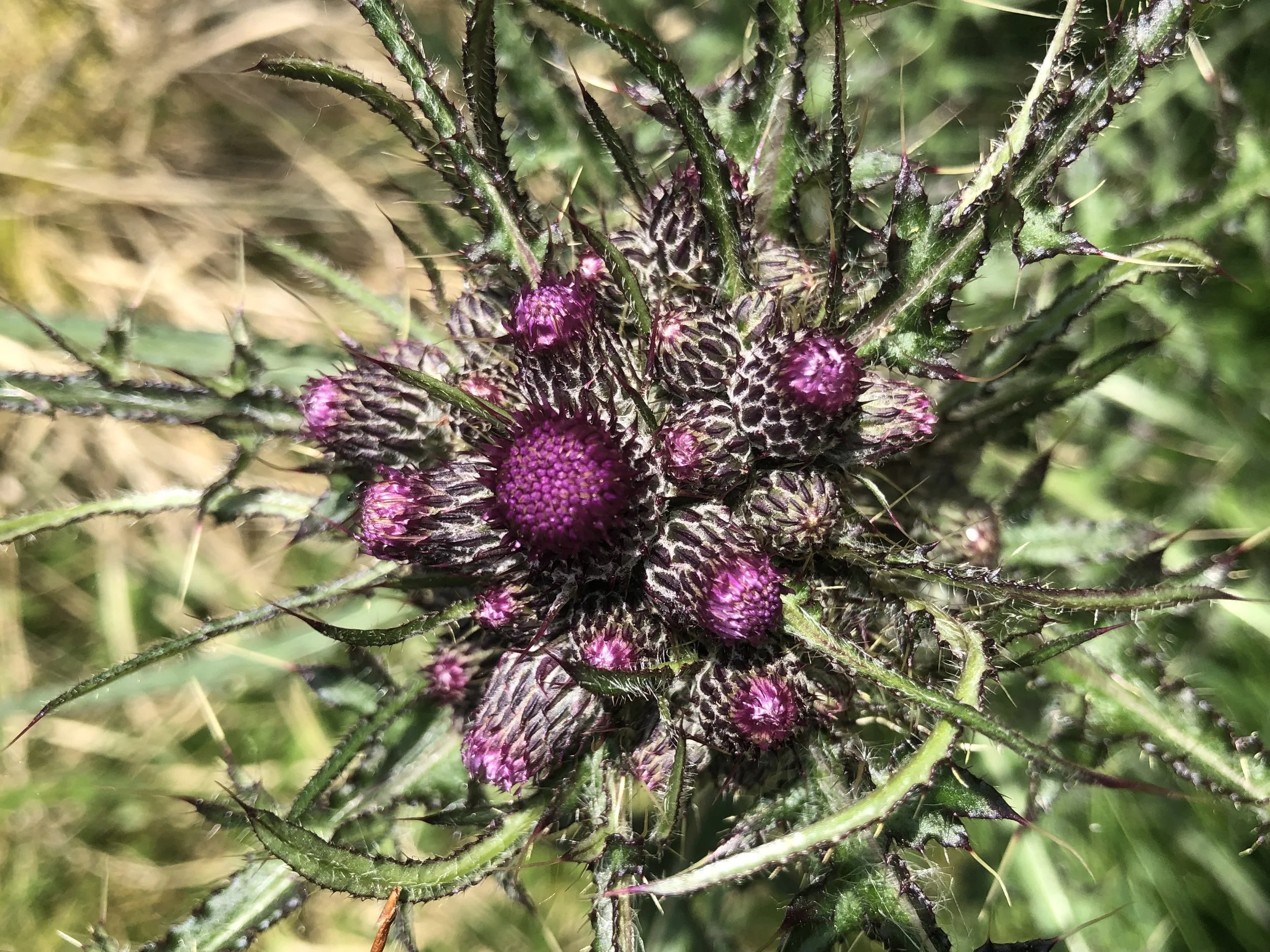
Marsh Thistle
Heath Speedwell
Bird’s Foot Trefoil aka Bacon and eggs
Silverweed
Yellow Rattle
Meadow Buttercups
Meanwhile at the nest box camera…
Clare had moved one of the cameras to cover box 3. From 8th - 17th May, the camera captured nearly 1000 videos. Some of these were triggered by movements in the tree and around the box, at least once by a bumblebee, by moving shadows and patterns of light movement; many may have been triggered by bird movements, however the time lapse from trigger to filming meant that birds did not always appear in the clips. Recordings started at about 5 each morning and continued every few minutes until about 8 in the evening. Clare confesses that to begin with she did not watch every single second of every video, however she did become more assiduous after opening one at random and seeing a Treecreeper, or maybe two, on the tree trunk. On 17th Oystercatchers are heard flying over.
The main drama is on 13th when a stoat leaps onto the box at 11.50 almost catching one of the birds. After this the Blue Tit is understandably hesitant to enter the box. One approach is especially gymnastic. The bird approaches the box many more times from the stoat’s visit until 13.24 when, on its thirty-second visit, it finally goes into the box and comes straight out again. It makes three more approaches before going in again and again comes straight out. Another four visits later and at 13.46, the bird goes in and doesn’t immediately emerge. The camera captures thirteen more visits before activity ends for the day at 18.48. The next day the bird’s activity seems less frantic. Perhaps a good night’s sleep helped.
The next few days produced over 1000 videos. Unsurprising as over the 21 days it takes for hatchlings to be ready to leave the nest, the parent birds have to provide about 1000 caterpillars each day. Both parent birds work at this task and they work seemingly non-stop. The earliest activity recorded for this period was at 04.46, the latest is at 20.58.
Here the birds come in with food within seconds of each other.
A Song Thrush has also been on the quest for food.
The next day there is another glimpse of a Treecreeper.
One of the parent birds seems very undecided about whether or not to deliver the grub it has brought. It’s the only time the camera has captured this kind of hesitation on the part of the parent birds. At first, in spite of there being no evidence to suggest it, Clare wondered whether the nest had been predated and the adult was puzzled not to find chicks. Thankfully that is not the case (thus far).
A small slow drama - at 10.33 a slug appears in the bottom right of the metal plate. It makes its way across the front of the box eventually reaching the entrance where it appears to look in. One of the Blue Tits encounters it - is it sending it off, tasting it, deciding whether it is food for the chicks? The answer will remain a mystery. Thirteen minutes after arrival the slug has gone. Where to? Another mystery.
It is not uncommon to see the parent birds hesitate as they prepare to leave the nest box, however the bird below takes a much longer time than usual. It may be sensing some nearby threat or perhaps it is just tired.
The next disc collection revealed nearly 2000 videos. This was somewhat daunting however Clare discovered that the batteries in the camera, unsurprisingly, had been failing and about half of the clips were only 2MG or so. A 15 second video is about 56MG. Clare managed to establish that the birds were still surviving at the end of the disc so she could delete half the videos without needing to watch them all. Working through the full length clips revealed the presence of a Jay causing alarm to one of the parent birds on 26th May. Jays will predate a nest. Then, and more alarmingly, there is another stoat attack. The stoat fails to catch a bird and the Blue Tits continue feeding the nestlings straight away. Clare needed more time to recover.
The next two days produce well over 1000 videos. Pretty much every one reveals the parent birds bringing in food or removing fecal matter. The work is relentless. As it is for Clare. She is combining the videos with catching up on podcasts. She reckons she can cover 100 videos during an episode of The Archers, considerably more during Round Britain Quiz and even more during Private Passions.
The camera captures Ruth coming to check on the species in the nest 27th. You can see how delicately she works and handles the bird. The hatchling was back in the nest within a minute and the parents resumed feeding straight away.
John and Clare are collecting the discs from this camera daily. There are usually between 400 and 600 videos each time. Morning activity has started earlier than previously - 04.29 - and continued later - 21.09. On the 29th May they show a parent bird waiting for quite a while with food outside the box before taking it in. The other bird does not emerge during these times. Clare is wondering whether the parent is starting to tempt the fledglings out of the nest. Ruth thinks they will be ready in two to three more days. Only a few more podcasts to go.
There is a third, and fleeting visit from a Treecreeper (not shown here).
Ruth arrives to ring the 8 chicks. Again you can see how gently she handles the birds. They are back in the nest within about three minutes and again the parents are straight back in with food.
We are told things come in threes. This has proved true for the Treecreeper and unfortunately it is also true for the stoat which arrives early in the afternoon of 29th. Happily for the birds, it leaves without taking any. Clare is not very good with suspense movies.
31st May
Clare went to collect the nest box disc before publishing this Blog post. All was quiet round the box whereas usually the adult birds make a noise while Clare changes the disc. Clare had a look inside only to find an empty box. The reason is revealed in the video below. Clare has stitched together all the relevant clips. While the video is a little over two minutes long, the episode took 39 minutes from start to finish. Clare rather likes stoats, understands they have to eat and recognises the colour of tooth and claw in nature, however in this instance she hope the stoat suffers from acute indigestion. The parent birds both continued to bring assorted bits of food for the remainder of the day and during the next, while occasionally seeming to hunt around the next box and display what in humans might be recognised as bewilderment and distressed behaviour.
The camera also captured two different avian visitors to the tree, a male Blackbird and a female, or possibly juvenile Chaffinch.
Remember that the Wildlife Trust’s challenge ‘30 Days Wild’ begins today. John and Clare hope you have a suitably wild time.