There are far fewer video clips this month than last however, as always to see what there are, you will have to access the Blog through the Liddells website: www.liddells.co.uk
Clare and John hope you have enjoyed going wild for the last 30 days and found many different ways to engage with nature. Clare has not listed every wild activity this month, reckoning that her habit of always being on the look- or listen- out for nature isn’t easily translated into a list. John too is rarely without an eye open for deer or hares. Clare has had a few days this month reading about one of the wildest, and the only named wind in the UK - the Helm. It is a phenomenon of the Eden Valley and surroundings in Cumbria and is very wild. The book is Helm by Sarah Hall and Clare recommends it as a particularly imaginative and engaging work of fiction.
John and Clare have been hoping to see this year’s new kids this month however for the first time since having trail cameras (2017), none have appeared. The old doe who has been around for several years and has had three sets of triplets and at least a couple of sets of twins, has not appeared in camera footage for quite a while. She may have moved into a different territory or she may have died. A younger doe, not apparently pregnant, suggesting she is a yearling, and possibly one of the old doe’s last year’s kids, has put in an appearance recently. Maybe she will have kids next year. John sees this, together with the territorial vying between three bucks, as a ‘changing of the guard’.
1st June
Clare made up hive frames ready for a new colony of bees.
She spotted a clump of Comfrey which has established among gorse at the bottom of the Scrub.. This is a great plant for pollinators. Bees with long tongues such as the Garden bumblebee and the Hairy-footed flower bee can reach into the long flowers, while bees with shorter tongues, such as the Buff-tailed bumblebee bite holes in the base of the calyx and can feed on the nectar without pollinating the plant. Honey bees and wasps can then benefit from the access to nectar.
Ragged Robin is out in profusion in several places on the Wetland and Orange Hawkweed is marching over the Meadow.
After the stoat/nest box debacle, Clare moved the trail camera to overlook a different box. Unfortunately there was quite a lot of wind and many leafy branches between the camera and the box, however there were clips of Blue Tits going in and out with food. Fledging was not caught on camera and when John looked in, he saw that some eggs had been abandoned although Ruth had ringed 8 nestlings from the box. The last sighting of a Blue Tit entering the box was dated 1st June.
2nd June
Clare tackled her annual Creeping Thistle pull on the Meadow and was pleased to find only 83 (she found about a dozen more over the next few days); the annual total is going down. She then set about the Blackthorn suckers that have begun invading the west end of the Meadow from the hedge there. She still has to face the challenge of the Hogweed. Joy is unconfined in Clare world. She was happy to see more Meadow Cranesbill in flower on the Meadow this year.
While Clare was on the Meadow she bagged up all the left over rubble from wall repair and used it to level the main path through the Scrub.
She noticed a Red-tailed bumblebee attempting to climb a grass stalk. It proved to be quite a challenge for the bee. A Large White butterfly was feeding on a Ragged Robin flower. There was a Willow sapling on the Wetland that had been broken by deer activity. It’s not unusual to see fraying damage however completely snapping a stem is less common.
4th June
The Orchids are emerging in abundance on the Meadow and in less profusion in other habitats on Liddells. All Common Spotted. The Meadow Cranesbill flowers are beginning to go over and form the cranes’ bill-shaped seed cases. While Clare was checking on the new hedging plants, she sensed she was being observed.
The fence post is watching you
5th June
Clare has been noticing a few Painted Lady butterflies in the garden and on Liddells recently; ususally only one at a time so it has been hard to determine numbers. This morning she read this article in The Guardian which heralds the arrival of potentially record-breaking numbers of the butterflies from sub-Saharan Africa for a ‘once-in-a-decade’ Painted Lady Summer. Blog readers who have read Isabella Tree’s Wilding may remember her describing such a phenomenon and how the butterflies benefitted from the Creeping Thistles at Knepp.
The Guardian also featured a piece on the use of tools by bumblebees. You can read here about how the bees moved and used a ball to secure a reward of sugar water.
6th June
A Great Tit investigates Box 8, which has been occupied by Blue Tits. Perhaps it lost its way from the sheer tiredness of feeding its offspring.
7th June
An exciting start to the day for Clare - her past bee-keeping mentor Ian delivered a nucleus colony of honey bees. The queen is newly hatched this season and marked white (there is a mnemonic to help remember the queen bee colour for each year: Will You Raise Good Bees? - white, yellow, red, green blue). Ian suggested transferring the bees into a full size hive within a couple of days. Clare spent some time watching the flying bees start orienting to their new situation.
8th June
With wet weather forecast for the next few days, Clare took advantage of a warm dry spell to transfer the bees into one of her hives. They were quiet throughout the process, more interested than irritated, which augurs well for a colony of calm bees. Their disposition comes from the queen.
The trail camera focussed on the nest box shows a pair of Great Tit adults attending to a juvenile. Again, they seem attached to this box, even though it was used by Blue Tits.
9th June
With another group due to visit Liddells later this month (Clare has checked the date several times), John started mowing the paths while Clare set about clearing the steps over the Point of View. She saw a Six-spot Burnet moth on Yellow Loosestrife leaves by the steps. Unfortunately she only managed an out of focus photo. Clare moved stones to replace the wooden edging to the steps and one stone split open as she moved it. It seemed to Clare that the impressions of leaves were fossilised into the exposed surfaces. Looking at the photos just now, Clare can see a rabbit on each side. Pareidolia rules OK.
14th June
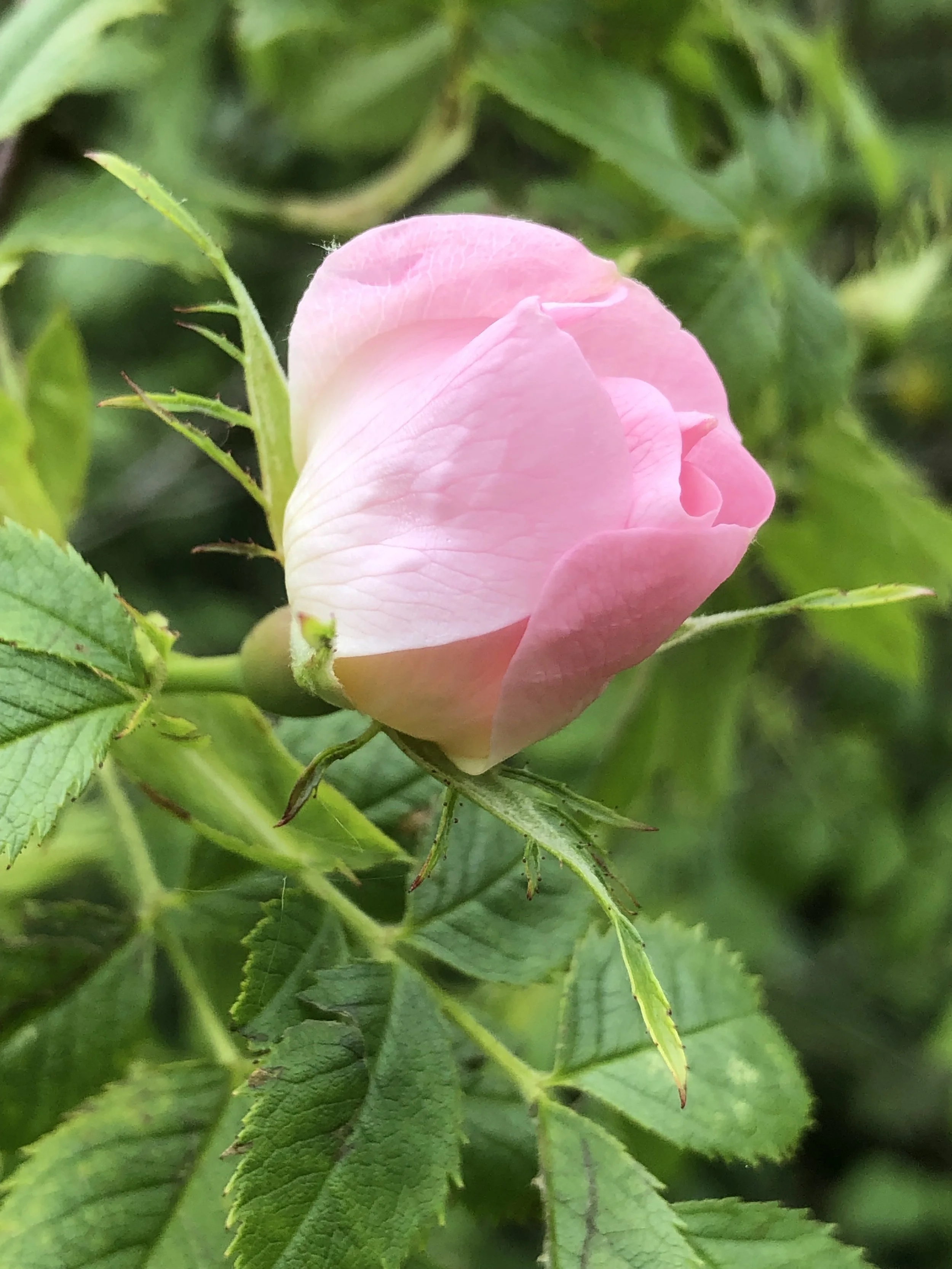
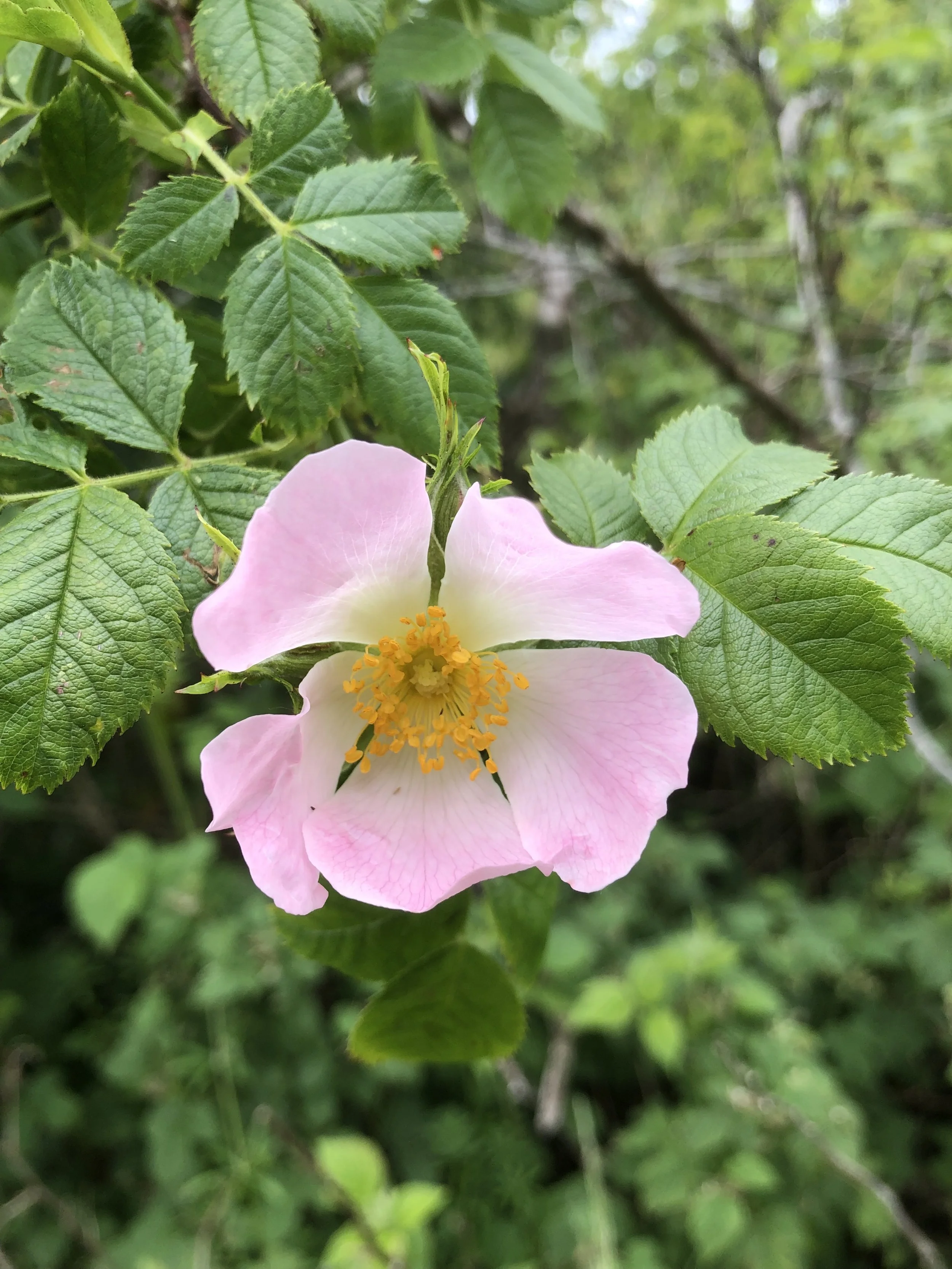
The Dog Roses are out all over Liddells. The honey bees are bringing in the orange pollen.
15th June
A young looking fox appears in the Scrub in the early morning light and seems to be wary of the camera.
16th -19th June
Clare and John pressed on with their preparation for the visit. Clare finished the steps; John finished the mowing and some sawing and decided his old saw horse needed replacing.
Checking in with the trail camera discs from the Scrub, Clare found numerous clips over several nights, of a bat flying around. Clare has stitched a couple of clips together below. John investigated the clips and thinks it is a Natterer’s bat. The pale underside is quite distinct. Natterer’s bats mostly fly around trees and quite low - exactly what this one is doing. You can read more about them here.
19th June
The last of the visit preparation and Clare returned the cleaned bird feeders to the hide (not to fill, but to store ready for the Autumn) and noticed that in the 24 hours since she walked the same path, there had been considerable deer damage to three Willow whips, two either side of Sylvia’s Willow Walk. The old buck is still around, however there are two younger ones vying for territory, and the young doe presumably. The rut begins in the middle of July.
The sight of Honeysuckle in flower offset dismay at the damage. New whips can be planted.
20th June
Thirteen members of the Ponteland branch of the Northumberland Wildlife Trust came for a visit. They had lunch in the meeting room while Clare and John spoke about Liddells - how they came to own the land, their aims, the work they have done to date and their hopes for the future - then Clare and John each took a group round. The group were very appreciative and clearly understood what was involved in the project as a whole. A 4-spot Chaser put in an appearance on Pond Maggiore along with many Common Blue damselflies. Clare noticed that some Viper’s Bugloss had flowered in the Meadow - this was one of the species planted on a recent Green Gym Day.
Val kindly sent photographs of the Cockchafer beetle she spotted on Elder. The Cockchafer is the UK’s largest scarab beetle. Wikipedia tells that:
‘In the Middle Ages pest control was rare, and people had no effective means to protect their harvest. This gave rise to events that seem bizarre from a modern perspective. In 1320, for instance, cockchafers were brought to court in Avignon and sentenced to withdraw within three days onto a specially designated area, otherwise they would be outlawed. Unsurprisingly, since they failed to comply, they were collected and killed. Similar animal trials also occurred for many other animals in the Middle Ages.’
Cockchafer
Viper’s Bugloss with Red and White clovers, Buttercups and Ribwort Plantain
Cockchafer
The young doe - possibly the only doe on Liddells now - is seen in the Scrub and regularly coming up the same path through the Pit Wood.
21st June
Clare opened her hive for the first time and was pleased to see the queen and plenty of eggs. They still had some syrup so must be finding enough forage from their surroundings.
Clare saw a family of at least ten Long-tailed tits, the juveniles cheeping for food, on the southern edge of the Pit Wood and a 4-spot Chaser and male Southern Hawker on Pond Maggiore.
22nd June
The rut is not far off. There is footage from the Scrub of the old buck barking, and of bucks chasing one another.
25th - 27th June
Clare and John decided on a different kind of gong wild and went away for three days - if you know them, you will know how wildly out of character this is. They chose a train journey so that they could travel from Inverness to Kyle of Lochalsh. The scenery was satisfyingly dramatic and the journey well worth making. Clare took a photo of a Scottish Thistle which looked particularly Scottish and one of a Giant Hogweed plant by the River Ness. There was a lot of Giant Hogweed along the rail tracks and in fields along the way. Touching Giant Hogweed can lead to severe chemical burns, large blisters, and long-lasting purple scars. Clare acknowledged that there is always someone worse off than yourself. At least she doesn’t have to dig them out.
28th June
Back to Liddells and Viper’s Bugloss has come out on the Hayfield. Hedge Woundwort is in flower in the Pit Wood and the Heather is coming out on the Crag. Clare spotted a Large Skipper on some Meadow Vetchling.
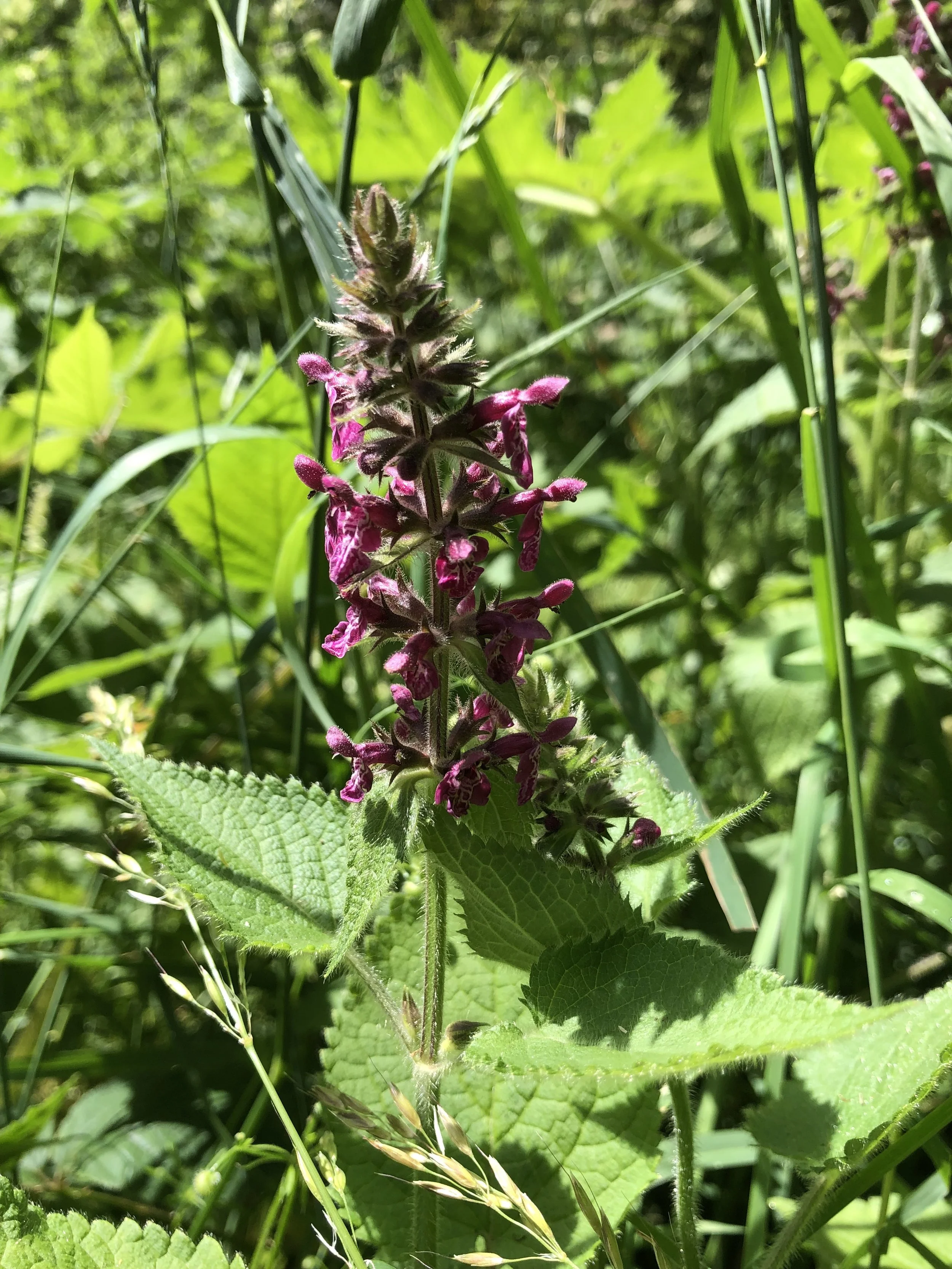
Here is Tim’s rather better photo of a Large Skipper on Bird’s Foot Trefoil, taken on 17th June
John had a close encounter with a hare late in the evening.
29th June
While John attended to the top gate which had dropped on its hinges, Clare went to the Meadow armed with a spit; but no sawdust. She dug up 30 Hogweeds which were in flower and half a dozen more which were just showing leaves. She found another 4 Creeping Thistles so those were dispatched as well. She rewarded herself by collecting Elderflower heads for this year’s cordial.
Coming down the Crag onto the Wetland later, Clare noticed a large excavated patch. Her first thought was ‘badger’, however she then noticed a lot of Buff-tailed bumblebees flying around. Disconcerted, Clare wondered momentarily whether they had excavated the ground for their nest. Realising this was a preposterous idea, she landed on the likely explanation: a badger had excavated the bees’ nest and the remaining bees were lost and disorientated.
Leaving the Wetland for the Pit Wood, she paused to photograph Marsh Valerian.
Marsh Valerian
From one nest to another - the day before the visit last weekend, Clare had lifted one of the corrugated iron sheets left in case any passing snakes or newts needed shelter. She found an extremely active ants’ nest. She thought this might be interesting to the visitors, so when they walked past the sheet, Clare lifted it and saw - almost nothing. The ants had moved all the eggs underground to safety. Today Clare had another look, and sure enough the ants and eggs were there in profusion. Possibly they won’t be by tomorrow.
A butterfly interlude in the Pit Wood - a Painted Lady, Ringlet and Speckled Wood each perched for long enough for a photo. The Painted Lady obligingly closed its wings so that Clare could photograph the underwing too.
Painted Lady
Painted Lady underwing
Ringlet
Speckled Wood
Clare noticed another clump of Viper’s Bugloss on the Meadow - a further success from the Green Gym planting day - and on the way to take a photograph, paused to enjoy how the Meadow has developed. She recorded Great Burnet in its usual place, Salad Burnet from the planting day (unfortunately neither Burnet photo came out clearly) and Lady’s Bedstraw also from the planting day, a Meadow Brown enjoying the warmth and a Meadow Cranesbill defying its nominative determinism by flowering outside the Meadow. Greater Knapweed threatens to take over the Meadow and may need thinning, however it provides late forage for pollinators so a stay of execution is in order.
Viper’s Bugloss
Lady’s Bedstraw among the Buttercups, Clover and Yellow Rattle seedheads
Greater Knapweed
Meadow Brown
(not) Meadow Cranesbill
Lastly this month, Clare noticed a web spun around a head of Red Clover on the Meadow. Moving closer in she spotted the spinner - it is a Nursery Web Spider. The Wildlife Trust's’ website tells us: ‘The nursery web spider is a common spider of grassland and scrub, and is often seen sunbathing among brambles and stinging nettles. The adults are active hunters and do not spin a web to catch food, instead using a quick sprint to capture flies and other insects. The female carries her large, round egg-sac in her fangs. When the young are about to hatch, she builds a silk sheet among the vegetation to act as a tent, sheltering them until they are old enough to leave on their own.’ The males have a trick up their sleeves, if indeed spiders can be said to have sleeves: ‘Mating is a dangerous game for male nursery web spiders, so they present a gift of food to the female while laying perfectly still and pretending to be dead. When the female investigates the food, the male will suddenly jump up and mate with her.’
Wild!