A reminder to all Blog readers - in order to see the video footage in this Blog post, you will need to access the Blog through the Liddells website: www.liddells.co.uk
2nd - 3rd April
The Willows and Wild Cherries are now in flower.
An early Easter egg hunt for Hal, Beth and Juno. While they were searching for eggs, Clare took the left over canes from the hedge planting and strengthened the Willow whips on the Wetland.
4th April
The Guardian reported on what is proving to be the ‘earliest spring of the century’. A study in Oxfordshire records Great Tits laying on 23rd March. The north-south divide is apparent as on Liddells the titmice are still building their nests. The article also states that ‘Fears that global heating could jeopardise wildlife with cold snaps killing off frogspawn…haven’t come to pass so far’ - they have in Northumberland. Apparently ‘the Willow Warbler has almost vanished and this is a proven result of climate change’. Clare and John have yet to hear a Willow Warbler on Liddells this year. It will be interesting to know Ruth’s ringing results; her ringing year begins on 30th April.
5th - 6th April
Storm Dave had blown some of the hedging tubes over so John and Clare effected a quick bit of repair work. John saw a Great Spotted Woodpecker near the feeders, a Tree Creeper at the top of the Pit Wood and a Stoat running along the wall there. Four Tree Sparrows were present at the feeding station, however they didn’t come on to the feeders while John and Clare were there.
John liberated some wood chip that had been left by the roadside - it will be used to top up the chip on the Point of View steps.
7th April
With Merlin’s confirmation, John heard a Willow Warbler on the north edge of the Scrub - good to know they haven’t vanished entirely from Liddells.
Many people are commenting on the profusion of Blackthorn blossom this year. Clare’s friend and avid Blog supporter Barbara said that a fellow supermarket queuer had spoken of the ‘Blackthorn Winter’. The phrase refers to the uncertain weather that often happens when the Blackthorn is out, settling down after the blossom has finished.
8th April
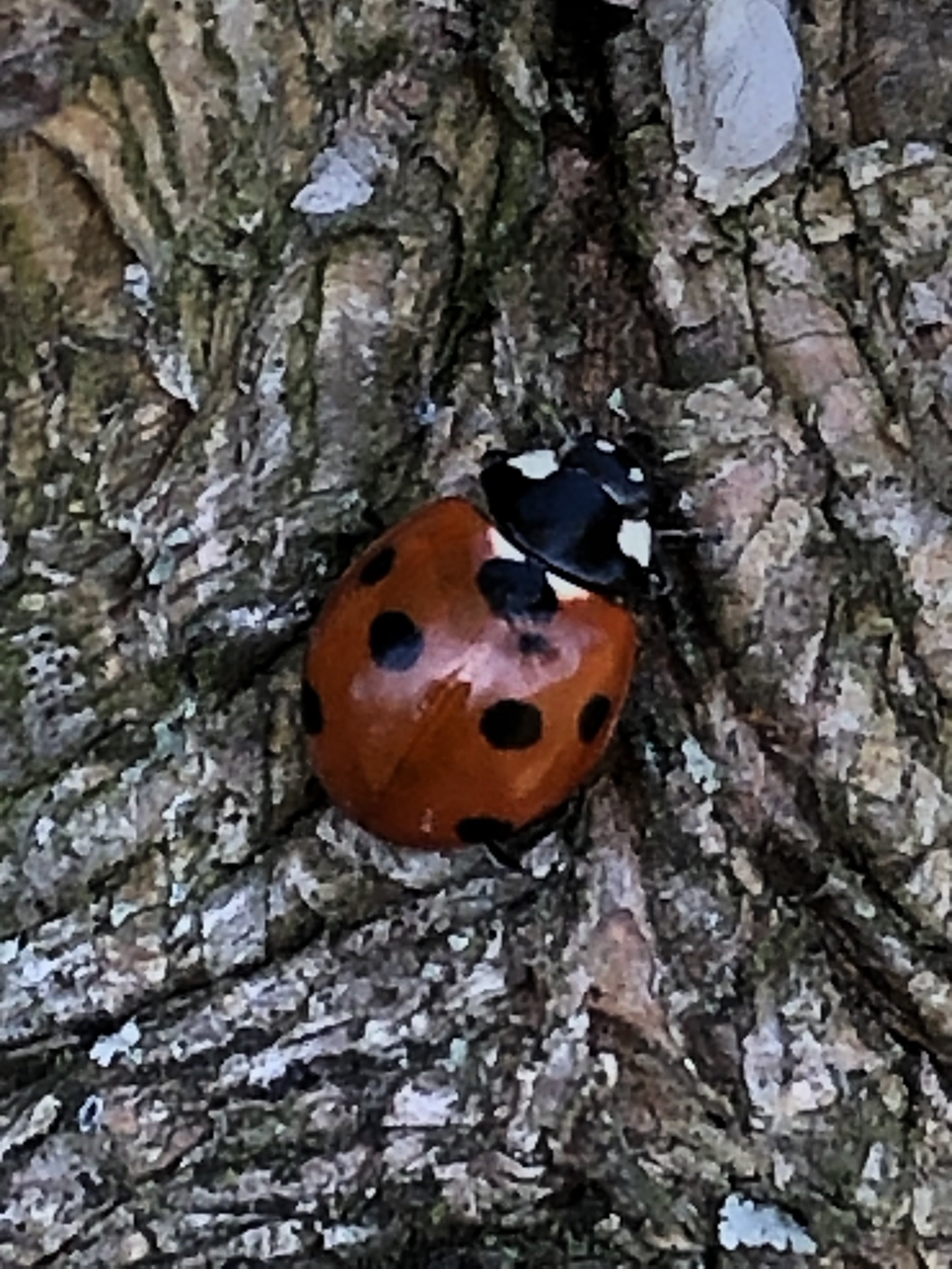
Prompted by yet another excellent post by Chris Wren on his TrogTrogBlog about recording ladybirds on small Scots Pine trees (you can read it here), Clare decided to investigate the five small Scots Pines on the Wetland. She has never seen a Pine ladybird and rather hoped she might. Chris is clearly a Ladybird whisperer - he found 10 species in total, a 7-spot on nearly every branch and Pine ladybirds on almost every tree. The Liddells trees were not such cornucopias, however Clare did see 16 7-spot ladybirds on the five trees and then another 2 on the small Yews in the Pit Wood. You can see how well the Ladybirds appear to merge into the pine cones.
These are the host Scots Pines
While she was inspecting the trees for ladybirds, Tim arrived on the second of the season’s butterfly transects.
Clare discovered that tadpoles had hatched in the Crag pond; you can see some have broken free of the large mass of tadpoles on the left of the clip.
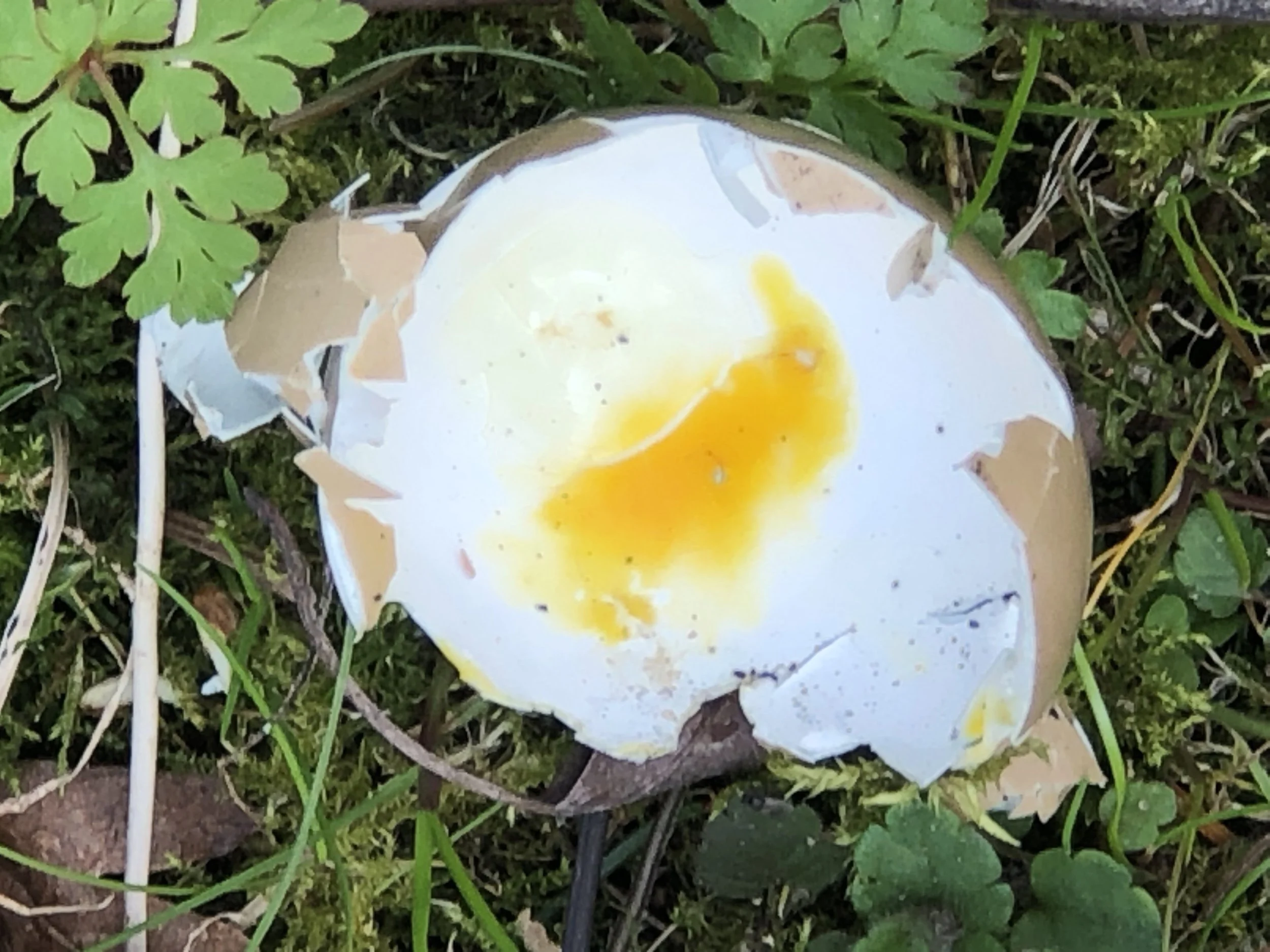
Energised by her Ladybird success, Clare went around noting plants in flower. She saw the first Dandelion, Wild Strawberries, another patch of Primroses in the Pit Wood, Common Dog Violet and a lot of Wood Sorrel in the Scrub (the one pictured had found its way into a fork in the tree); she also discovered that her family were not the only egg hunters around and that something had attacked the roof of one of the nest boxes, probably a Woodpecker. The loss of the Pheasant eggs may seem sad, however the Pheasants eat food that would otherwise be eaten by, for example Dunnocks, Robins, mice and voles. The eggs provide a meal for foxes, stoats, etc..
The strap belongs to one of the trail cameras
The host Hawthorn
12th April
John watched two hares boxing on the Hayfield today.
13th April
Clare found the first of the year’s Cowslips in flower under one of the Spindle Trees. Neither Clare nor John have planted any here, or indeed anywhere else on Liddells.
John set about some trailer repair. Hal has asked why John doesn’t use the smarter trailer that is currently stored in the Pit Wood - John, having replaced pretty much every part of the old one, is just far too attached to it!
15th April
Clare arrived to meet Ruth on Liddells. While she was waiting she saw the first Red Admiral of the season near the Meadow and counted at least 12 Bumblebees collecting pollen at the top of one of the Goat Willows.
Ruth’s ringing season begins soon so she was checking on equipment and deciding which nets not to use this year - at the height of the season lat year six nets proved far too demanding to manage. Ruth spotted a skeleton by one of the Willow seats. John confirmed it is of a small roe deer, possible one of last year’s young; he also managed to find part of one of the cleaves (hooves). Clare has cleaned the skull and will add it to her nature collection for visitors’ interest. Any squeamish readers look away now.
15th April
Clare set about pruning some of the Hawthorns that would compromise Ruth’s nets. On her way round she found two eggs - one a Woodcock’s and the other a Blackbird’s. The loss of a Woodcock egg is particularly sad as the birds are red-listed. The eggshells will join Clare’s nature collection.
The two remaining trail cameras have both lost any coherence when it comes to recording the date, so it is unclear when the footage is captured. Here is a selection of videos that were taken between the 12th and 15th April.
15th April
Clare heard the Willow Warblers singing.
This is the recording Clare made through Merlin - you can hear Robin, Blue Tit, Willow Warbler, Chiffchaff and Dunnock.
17th April
Clare planted 18 Oaks, 4 Rowans, and a Horse Chestnut all donated by John M and a further Horse Chestnut donated by Pat.
18th April
The birds captured in the recording above may have been females. An article in The Guardian today features a new guidebook The Sound Approach to Birding 2. One of the researchers, Lucy Mc Robert, says female birds sing for territorial display, to ward off other females and to attract males. She says, ‘We’ve got a completely false narrative around female bird sounds and female birdsong’; the narrative’s assumptions were drawn by the largely male ornithologists of the past. You can read the article here.
19th April
The original Bird Cherry in the Orchard has more blossom than ever before and the Bird Cherries planted for and by the Community Choir are in blossom for the first time.
Clare saw a Holly in flower in the Pit Wood and had another look for ladybirds on the Scots Pines. She only found a couple however a pinhead of bright green caught her eye and she wondered whether it was a Pine aphid, however as she looked she saw legs emerge. The insect was a Cucumber spider. Read more about them here.
The first Bluebells are opening in the Top Strip with a lot more to come.
21st April
John saw two pairs of hares boxing on the Hayfield. They seemed completely oblivious to his presence and work on the trailer.
John and Clare have decided to follow the RSPB advice and stop feeding birds until winter. Bird feeders, particularly if they are not cleaned regularly, can be a way in which the highly infectious disease trichomonosis, is passed on. There is also a risk that birds such as the Willow Tit are out-competed by titmice. This may account for the absence of Willow Tits on Liddells recently.
John and Clare were delighted to see this footage of a leveret in the Scrub. The black tips to the large ears are identifiers.
22nd - 23rd April
Clare and John prepared for the next Green Gym Day. Clare has been growing on wildflower plug plants in the vegetable beds at home for a couple of years and the plants are ready to be moved. Accordingly John and Clare dug up, separated and sorted all the plants, listing where on site they could go. The plants filled the back of the, now splendidly repaired, trailer.
25th April
Green Gym Day - Janes E & B, Sally, Pat, Fran and Barry all joined Clare and John to plant several of each of 14 species of wildflower, mainly in the Meadow and on the Hayfield, but also on the Wetland, in the Pit Wood, on the Spoil Heaps, in the Scrub and by top and bottom roadsides. All was done by 12.30. Fortified by lunch and the customary baked goods, including Anzac biscuits as this was Anzac Day, Sally, Pat, Jane E and Clare sowed seeds that Clare had collected last year from 12 species of wildflower. The planting included Viper’s Bugloss, Salad Burnet, Great Burnet, Skullcap, Great Willowherb, Nettle-leaved Bellflower, Wintercress, Black Medic, Great Burnet, Betony, Field Scabious, Musk Mallow, Yarrow, White Campion, Lady’s Bedstraw; the seeds were from Great Willowherb, Red Bartsia, Musk Mallow, St John’s Wort, Sweet Cicely, Bladder Campion, Salad Burnet, Field Poppy, Agrimony, Weld, Wild Carrot and Yarrow. Some of the seeds were from the plants grown in the vegetable beds. A good dose of rain will now help. Not all the plants or seeds will establish, however even if some do, the exercise will have been a success.
Clare was so absorbed by the activity, she completely forgot to take photographs until packing up at the end. The debris in the trailer will have to stand as proof of the work, as do Pat’s, Sally’s and Jane’s pleased faces. Clare did notice Bugle in flower and took a photo of that.
Walking home Clare was thrilled to hear and then see a Whitethroat in a hedge near home. She hasn’t heard them on Liddells yet, however she will be listening particularly carefully in the next few days. Whitethroats are territory loyal so maybe the ones that bred on Liddells last year will return.
A later inspection of the trail camera discs illustrated the idea of setting a thief to catch a thief - the camera captured two images of corvids each with an egg in its beak - most likely from the Mallard nest in Pond Maggiore. Caught with egg in the face.
A photo from later that evening showed a pair of Mandarins on the pond - they nest in trees so the eggs would not have been theirs. Next day a Mallard drake appears, presumably to discover the robbed nest.
28th April
Today will be etched on Clare’s mind for a while. She likes to think of herself as a fairly well organised person. At 11.30 she had a call from Ruth who was setting up her equipment ready to start ringing on Thursday, to say that a party of walkers had arrived at Liddells ready for their tour. Clare had wrongly written this event in her diary on 28th May. John had it on the correct date but deferred to Clare’s assertion that it was in May. Haltwhistle Walking Festival had included a visit to Liddells in one of their walks. John and Clare made it up to the land as fast as they could and the group and particularly the leader were more than magnanimous about the gaffe. The party had a break for drinks in the Meeting Room while Clare and John talked to them about Liddells and their past and ongoing work. They then split into two groups, one having a clockwise tour and the other anticlockwise, before coming back to the Meeting Room for lunch. John and Clare suggested it was likely they would see a hare and one group saw four running across the Wetland and the other group saw a leveret. It was clear that the visit was a success and John and Clare enjoyed taking round such an animated, interested and appreciative group. In the dash from home Clare forgot to pick up her phone to take photos, however Wendy forwarded some taken by members of the group. Clare spend the afternoon recovering. On the plus side, the ‘To Do Before 28th May’ list is now redundant and John is many ‘I told you so’ points in credit.
Coffee break
John talking about the nest boxes
Lunch break
John having a Point of View
Peter, one of the walk guides
The views were great
Orienting in the landsacpe
Clare heard the first Garden Warbler of the year in the Top Strip and Merlin confirmed this. Ruth heard one nearer the Orchard. The birds usually arrive at the same time as the Whitethroats so all digits are crossed.
29th - 30th April
John and Clare set about watering the newly planted wildflowers.
Having seen abundant berries on local bilberries, Clare had a look at the ones on the Crag and they are covered in developing fruit. Maybe a Green Hairstreak will be tempted by them this year.
While stacking logs, Clare noticed there was something sticking out of one of the Swallow cups in the log shed. Rather gruesomely it proved to be a decapitated female Blackbird. The bird was resting on a small quantity of moss and feathers. It is all rather perplexing. Neither Clare nor John have any idea how long the corpse has been there. The fragments of nest are not characteristic of a Blackbird, indeed the Swallow cup is smaller than a Blackbird’s nest. The bird was ringed so Clare and John will ask Ruth if the ring can shed any light on the matter.
Clare is planning to be up with the larks on Sunday to witness the dawn chorus on International Dawn Chorus Day. It will be good practice for the next day when she will be up for a lark with her Community Choir to sing in the sunrise at the local Bandstand. John will be enjoying his sleep.
Advance warning for Blog readers - the Wildlife Trusts will be promoting their usual 30 Days Wild in June - there is still plenty of time to think about how you might engage with that.