* from Sonnet 97, William Shakespeare
Please remember to access the video footage in this Blogpost through the Liddells website: www.liddells.co.uk
1st December
The camera focussed on plentiful acorns on the path below the apiary is capturing much foraging. Unfortunately the quality of the footage isn’t great, however you will gather a sense of how much activity there is. The Pigeon in the second video seems to swallow an acorn whole; in the third, the pigeon on the right appears to change its mind and spits out an acorn.
2nd December
More clearing from the Ash felling. Clare decided it was like a giant game of Spillikins. She found a couple of particularly well-named examples of Jelly ear fungus: Auricularia auricula-judae
One of the feeders at the hide has been set upon by a determined creature. John and Clare suspect a squirrel, although the indentations could be from a corvid’s beak.
Ears
Spillikins
Feeder damage
5th December
The buck kid adds to the list of acorn foragers.
Today Clare noticed a different fungus while clearing, sawing and stacking Ash branches. This one is possibly Barnacle lichen, although she is unsure about the identification. Relaxing in the hide after the work, Clare counted twelve Goldfinches - the most seen together at the hide in a very long while and seven managed to use the nyjer seed feeders at the same time. Clare was delighted that a flock of Fieldfares and Redwings came briefly into the Hawthorn in front of the hide. They didn’t stay long however one Redwing perched for long enough for Clare to attempt a photograph. While the bird was easy to see with the naked eye, Clare found it much harder to locate it using her phone camera.
Maybe Barnacle lichen
Spot the Redwing (Spot is not the bird’s name)
6th December
Assorted birds forage around and on the acorns: female and male Blackbirds, Pheasants (lots), Robin, Blue tit, Coal tit, Chaffinches, Fieldfares, Redwing. Even a hare has a sniff around. The footage of the hare is the clearest, so here it is followed by footage of a Redwing. You can just detect the flash of red under its wing and hear the whistling call as it flies off.
7th December
Rewards for Ash clearing today included a patch of Yellow Brain fungus, some more and more Barnacly fungus, a 7 spot ladybird and a satisfying stack of logs.
Winter fu-uel
Another hare or the same hare has a hunt through the leaf litter.
9th December
The buck kid - note the buttons where his antlers are beginning to develop, spent over 15 minutes foraging on the path, wandered off then returned 15 minutes later for another 3 minutes. Here are a couple of clips - you can see the thickness of his winter coat.
10th December
There seem to be more Pigeons around Liddells than in previous years. Here a group forage together on the path below the apiary. The most common collective noun for Pigeons is ‘flock’ with ‘flight’ used when the birds are on the wing. Racing Pigeons can be called a ‘kit’ or a ‘loft’, while numbers of urban Pigeons have been called a ‘dropping’ or a ‘plague’. Clare prefers her term for the ones on the path.
11th - 16th December
John and Clare decided to move the trail camera from the path to the Top Strip. The last of the videos from the path showed the button buck returning (not included here) and a Jay collecting more acorns, probably to store them and then forget where. More Oaks for Liddells if that proves to be the case.
17th - 24th December
The camera at the end of the Orchard has decided that Clare’s seventy-second birthday must be fixed in time. Whatever reprogramming Clare and John operate on the camera, the camera has a mind of its own. The camera captures many movements in and out of the Pit Wood, most of which in the last few days have been hares. Here are a couple apparently practising for Spring activities.
The camera newly positioned in the Top Strip has mainly captured clips of sheep. An adventurous, or possibly hungry group has broken out of the Hayfield in search of food. When Clare went to collect the discs she had to do some impromptu shepherding as three sheep had got their heads stuck in the sheep-proof fence. Does this mean the fence is or isn’t effective? One of the animals required Clare to think about the manipulations of childbirth as she twisted the head to free one ear then the other. Not one of the sheep said a word of thanks.
The incorrect dates on these clips are due to human error - forgetting to reset the date after adding new batteries. Again.
The presence of the sheep in the Top Strip possible accounts for the alarm shown by one of the two deer - its caudal patch is prominently erect.
Twelve Wild Days
Clare decided to take up the Northumberland Wildlife’s Trust to engage with nature in some way or another over the twelve days of Christmas. Here is the result of her challenge thus far:
25th December - the first day
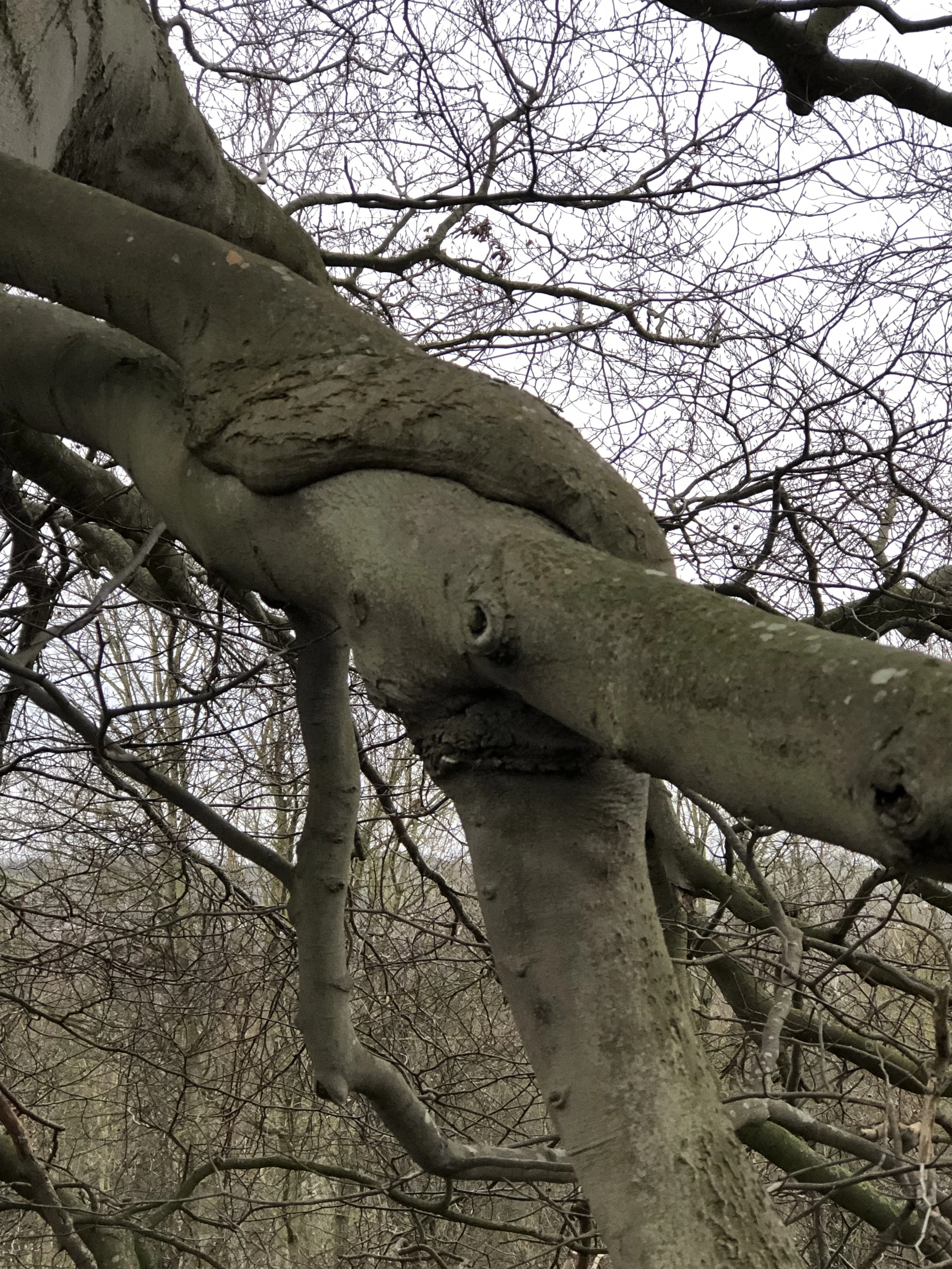
A serendipitous encounter with a friend in her car to start the process and an example of inosculation.
26th December - the second day
Hazel catkins are in abundance in the Top Strip.
27th December - the third day
A walk through local woods enabled Clare to adopt the role of nature teacher to Hal and Juno - she pointed out the tiny pine cones at the end of the Scots Pine twig, evidence of squirrel nibbling on the pine cone and the berries on the ivy which are food for Blackbirds, Thrushes, Blackcaps, Starlings, and Woodpigeons, Redwings and Waxwings.
Clare read the most recent RSPB and Roebuck (Northumberland Wildfife Trust) magazines. She especially enjoyed the articles on Holly and mosses in Roebuck.
28th December - the fourth day
A surprise encounter with a small elephant and a great example of pareidolia. As Hal pointed out, the elephant certainly has a trunk. Clare also noticed a cow with a crumpled horn and hoped it hasn’t been tossing any dogs. The cow is a Longhorn.
Clare identified 21 different bird species on her walk today: Buzzard, Kestrel, Pheasant, Carrion Crow, Rook, Magpie, Jay, Blackbird, Robin, Dunnock, House Sparrow, Wren, Coal Tit, Blue Tit, Great Tit, Fieldfare, Redwing, Common Gull, Black-headed Gull, Wood Pigeon and a single Goldcrest. One hedge was quite noisy with House Sparrows. The Pigeons on a wire nearby look quite organised in comparison.
29th December - the fifth day
Clare saw a charm of Goldfinches and then heard and saw a small flock of Nuthatches.
30th December - the sixth day
A walk with Jane B (her longest since a recent knee op) and the delights were many. First a Little Egret, then a male and female Goosander, then, oh joy, a Kingfisher came and perched on a small branch close by. On the return route the Little Egret reappeared as did the Kingfisher and another male Goosander. Neither Jane nor Clare had any wish to sound greedy, however they did remark that they hadn’t seen a Dipper. At the end of the walk they went a bit further to have a look at the river from the road bridge and two Dippers dipped before flying off into the undergrowth on the bank. Seconds later and Jane and Clare would have missed them.
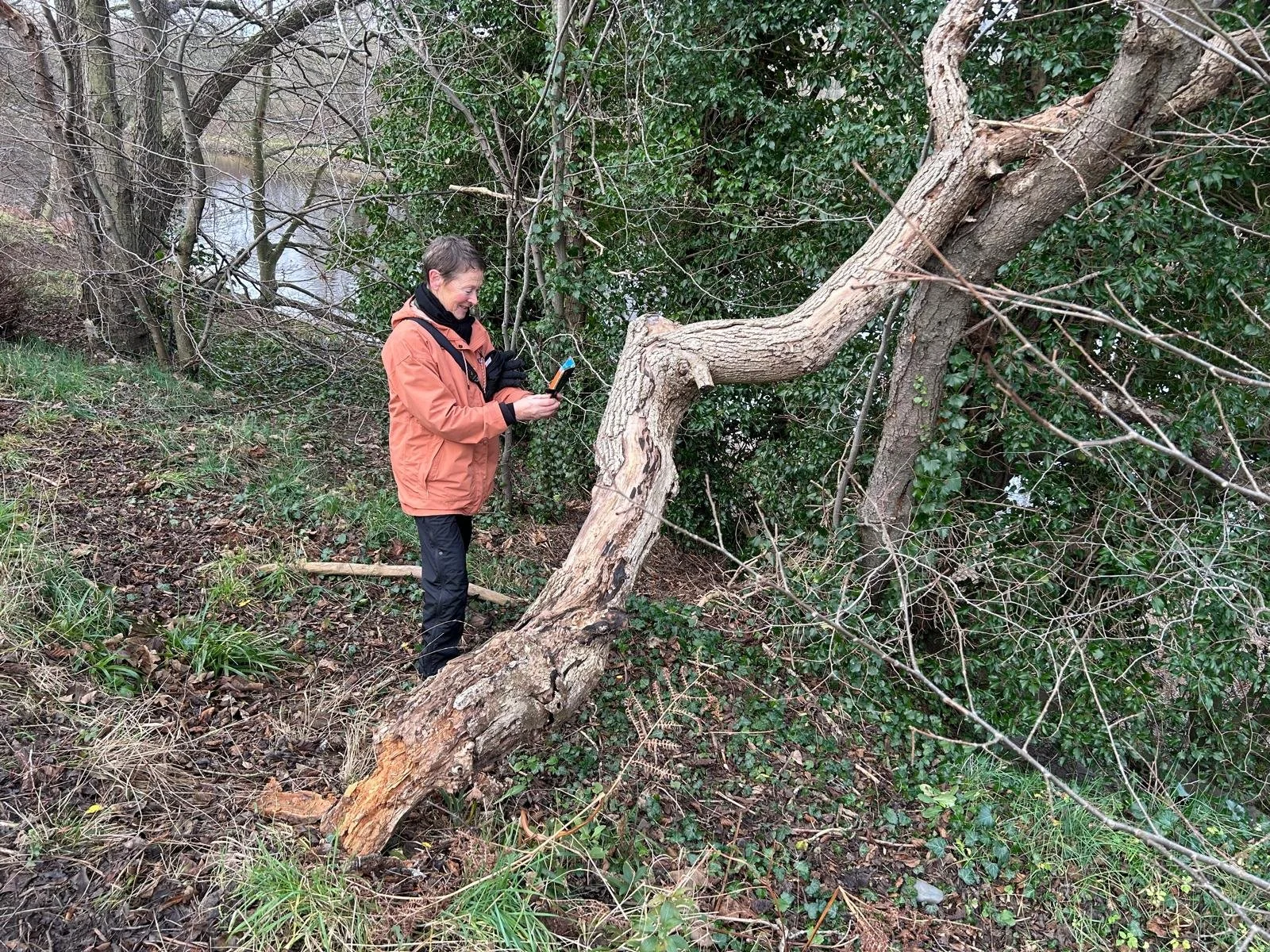
Clare had looked earlier in the day at Uncommon Ground: A Word-lover’s Guide to the British Landscape by Dominick Tyler and had noticed the word ‘daddock’. It is apparently a dialect word for rotten wood. ‘Daddock implies a dry, crumbling rot that might …dessicate standing wood to provide tinder. Some of the old dialect dictionaries give ‘daddock’ as a synonym for ‘touchwood’, a word derived from the Old French ‘toucher’ meaning ‘set fire’, hence ‘touch-paper’. Every day a school day on the Blog.
Below is the daddock Clare spotted, the black fungus growing on it - King Alfred’s Cakes Daldinia concentrica, which are round, black and hard; they are named for their resemblance to burnt cakes, they make excellent firelighters - and Jane’s photo of Clare capturing the fungus on camera. Clare finds it pleasing that both the fungus and its rotten wood host are good for fire-lighting.
31st December - the seventh day
Ahead of a family visit to Liddells Clare discovered the entrance to a rabbit burrow very close to a Field Maple and then another hole although this time made by a Labyrinth Spider in the Shepherd’s Hut.
More Twelve Wild Days will follow in the New Year. Meanwhile an excellent way to have an encounter with nature, if you haven't already discovered it, is to have a read of Chris Wren’s magnificent TrogTrogBlog: https://trogtrogblog.blogspot.com/ He has published several end-of-the-year favourites recently and offers wonderful footage of otters, stoats, weasels and even a polecat, birds incuding the elusive Water Rail and more besides.
At this time of the year, the funnel webs in our gardens are normally the work of Labyrinth spiders. Labyrinths are common, shy little creatures, and being a dull grey-brown colour they go largely unnoticed. It's only when they start building webs that they draw attention to themselves.
At one end of the web there's a funnel shaped retreat. In fact the web is really quite a magical piece of defensive architecture, designed to protect the spiders eggs.
An end of the year check on the trail cameras showed a hare having a good stretch and the doe chasing off the buck kid in what looks like an unusually forceful manner.
Liddells is a good place to mark the end of the year and a fire for toasting marshmallows is all part of the ritual. Hal, Beth and Juno brought another family with them. As they left Clare hoped they might come again whereupon the younger son replied, “Who wouldn’t want to?” A heart-warming end to the year.
Wishing all readers a Happy New Year and thanks for supporting the Blog.